What's Behind My Shower Handle? — Shower Valve Explained | RoughPlumb
The handle and trim are only the visible controls. Behind the wall, hot and cold supplies feed a valve body that controls water before it travels to the shower head or tub spout.
COMMON SYSTEM CONCEPT — valve construction, cartridge design, diverter arrangement and service procedure vary by manufacturer and model.
What is the shower doing?
Use the symptom to narrow the system before ordering a cartridge or opening the wall.
Part identification: visible trim can help narrow identification, but the internal cartridge or valve may still need to be verified. Useful photos include the full trim, handle removed, trim plate removed when safely accessible, exposed cartridge/stem, and the removed cartridge from multiple angles.
What You’re Looking At
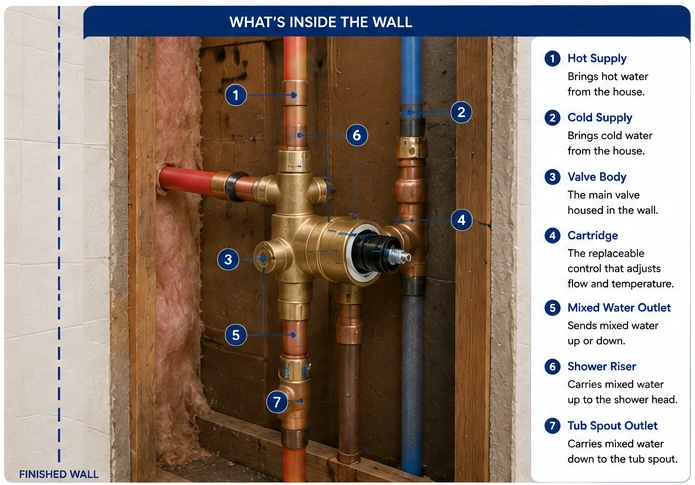
See the hidden valve body, cartridge location, hot and cold supplies, shower riser and tub-spout outlet behind common tub/shower trim.
How It Works
Hot and cold water enter the concealed valve body. In many modern valves, a replaceable cartridge or similar internal control affects shutoff, temperature, mixing or flow depending on the design. Mixed water then leaves toward the shower riser or tub-spout outlet where applicable.
Common Symptoms
- Shower drips after it should be off
- Shower will not get hot enough
- Low pressure at this shower
- Water appears around the trim or inside the wall
Common Causes
- Cartridge or valve sealing/restriction issue
- Temperature-limit adjustment or hot-water supply issue
- Shower-head restriction or a broader pressure problem
- Leak at a valve connection, valve body, shower riser, tub-spout connection or another concealed supply connection
Common Mistakes
- Replacing a part before confirming the failure path
- Changing piping before checking the surrounding system relationship
- Treating a simplified visual as a jurisdiction-specific installation drawing
What the Visual Shows
- Hot supply
- Cold supply
- Valve body
- Cartridge inside valve
- Mixed outlet to showerhead
- Optional tub-spout/diverter path
What You Can Check
- Compare hot water and pressure at other fixtures before blaming the shower valve
- Check the shower head for restriction when pressure is low
- Photograph the full trim and exposed stem/cartridge before ordering parts
- Shut off water before removing internal valve components
Safety & Scope
Local plumbing codes and manufacturer instructions apply. Shut off water/energy where required and escalate concealed, sewage, structural, gas, electrical or uncontrolled-leak conditions.
When to Call a Plumber
Call a qualified plumber when the problem involves concealed piping, sewage, uncontrolled leakage, structural work, water-heater safety devices, uncertain code requirements, or multiple fixtures/system branches.